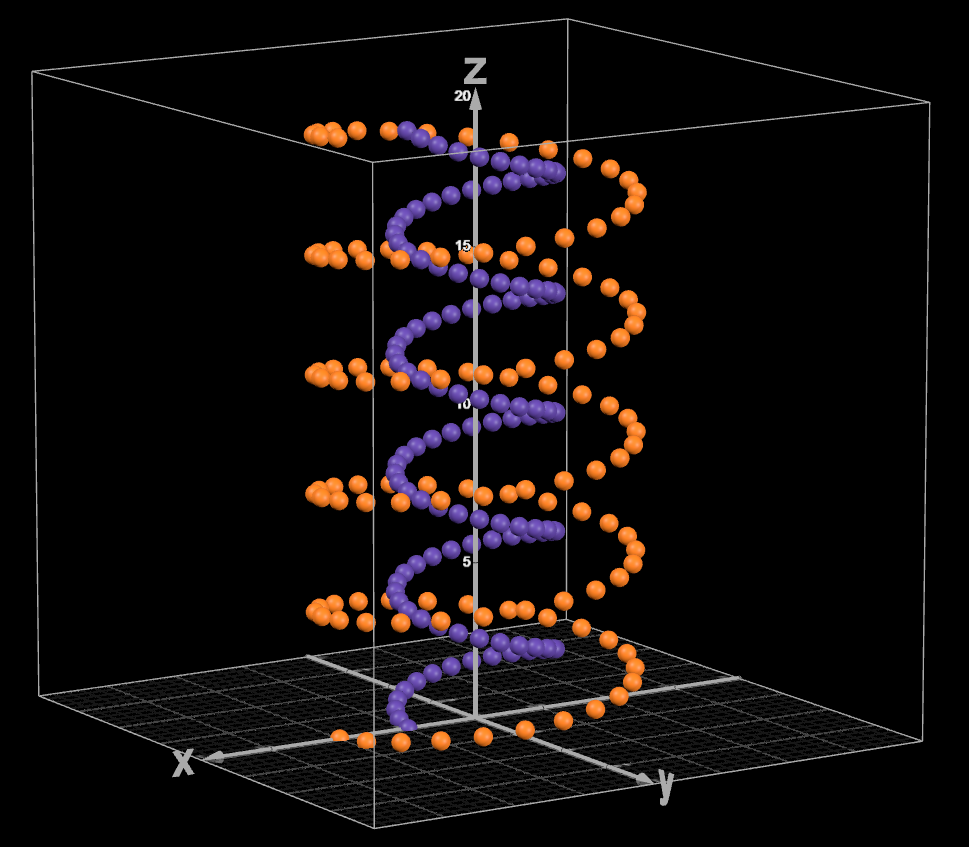
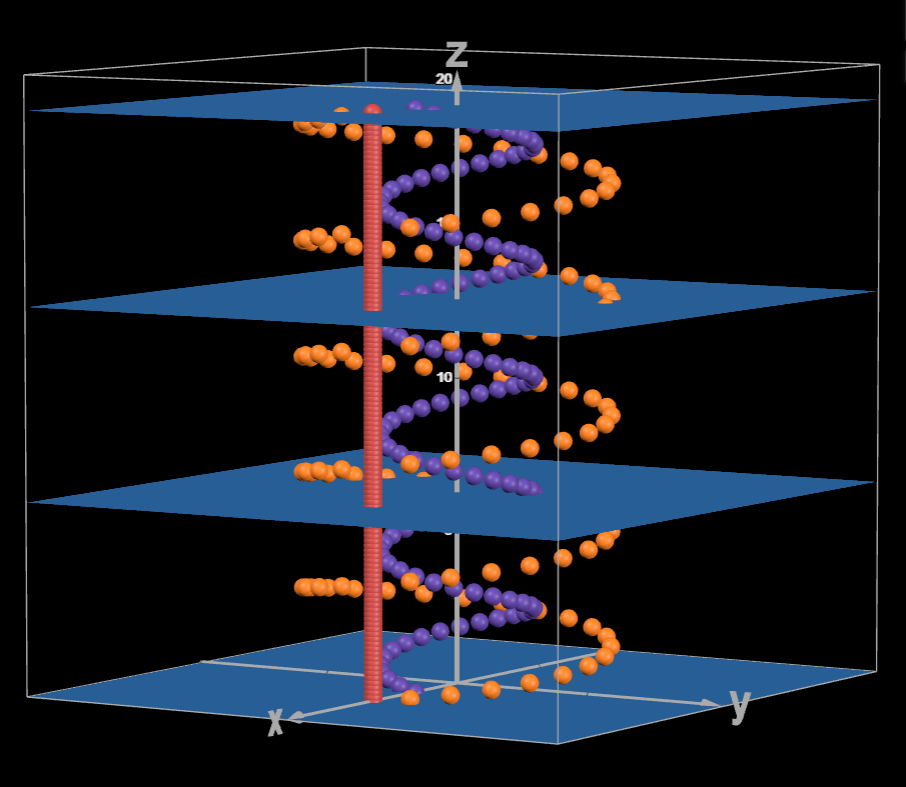
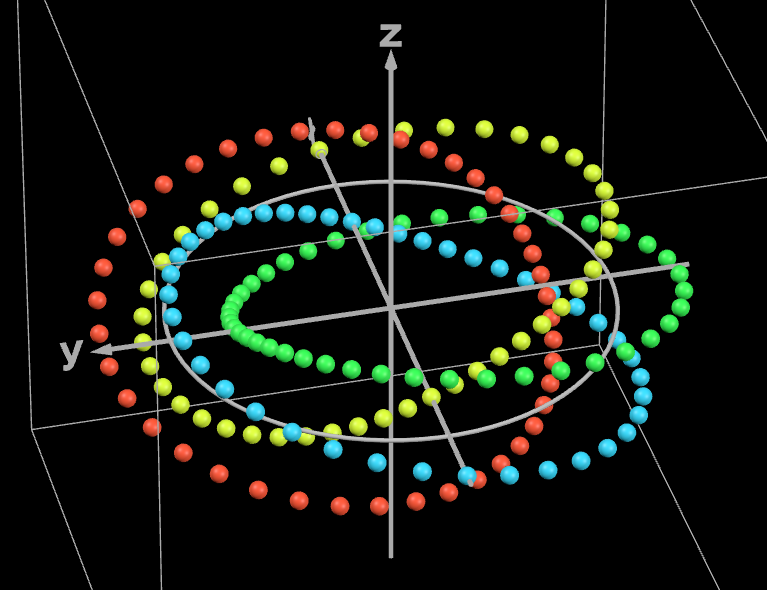
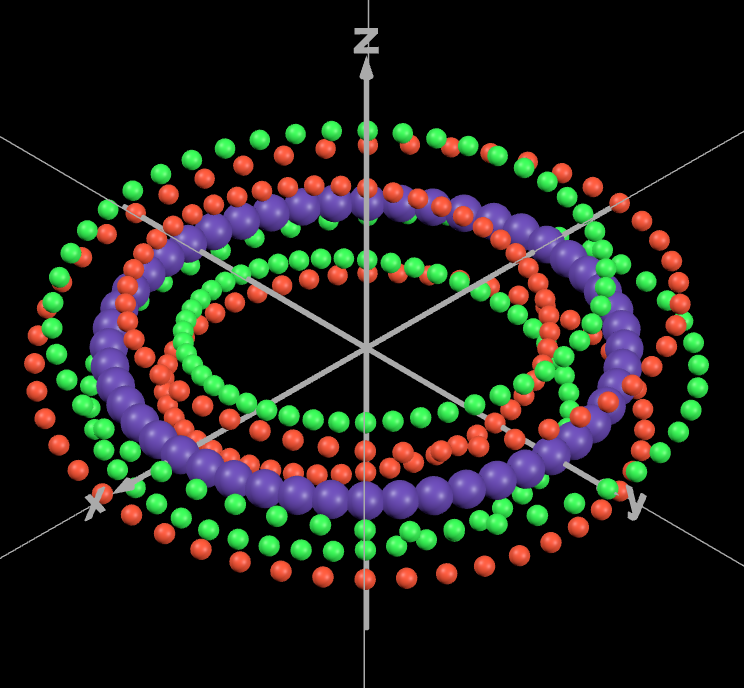
TwistingA torus defines circular object made of either a zero thickness shell or a rod. In the latter case, the torus is assumed to contain something bounded by the donut shape. This content can be of any kind: a solid, a liquid, a gas, or a physical field. Torus and its toroidal axis are depicted using standard equations, see them in the Torus section. They differ only in poloidal radius. Content of the torus may perform twisting on the go along axis of the tube. The most interesting case is when such torsion is synchronized. After one turn or more, any particular point returns exactly to the position where it started. Such coincidence describes so called standing wave - a sort of resonance. Unbent torus shown to the right illustrates how single dot travels along the torus during toroidal and poloidal twists. Blue cross sections separate each full turn accross the torus via toroidal axis. Click on the picture to see animation. These colored beads on the torus surface denote so called geodesics of the torsion. This project uses dot-based visualization method to provide see through effect. Geodesics is granulated along its path using normalized coordinates for an entire circulation defined by torus knot setting. It is described using next equations. While equations for smooth surface require continuous angles θ and φ, dot-based view operates with sets of discrete numbers. Equations for Cartesian coordinates update accordingly. Given two sets of granulations, one per each angular coordinate, geodesics are produced by simple crossing of these sets. This project highlights each poloidal set with different color. Dots within a toroidal set appear in the same color. Last two pictures serve the purpose to illustrate how nontrivial toroidal twists can merge together. A subset of normalized coordinates is extracted for a single toroidal turn. Then these coordinates are duplicated times the torus knot factor and shifted accordingly. It allows to compute mean coordinates for dots having the same offset from the start point (0). Shown result is depicted using violet balls. Rotational passes altogether form a symmetric structure for knots having . Only single pass knot demonstrates variety for poloidal phases. All other knots converge at a single violet circle.
| Sections
Tools |
4s 2026-03-23 16-14-48.PNG)
4n 2026-03-23 16-14-48.PNG)